
Solid Moisture Analyzer

Important Links
 Safety Operating Procedure
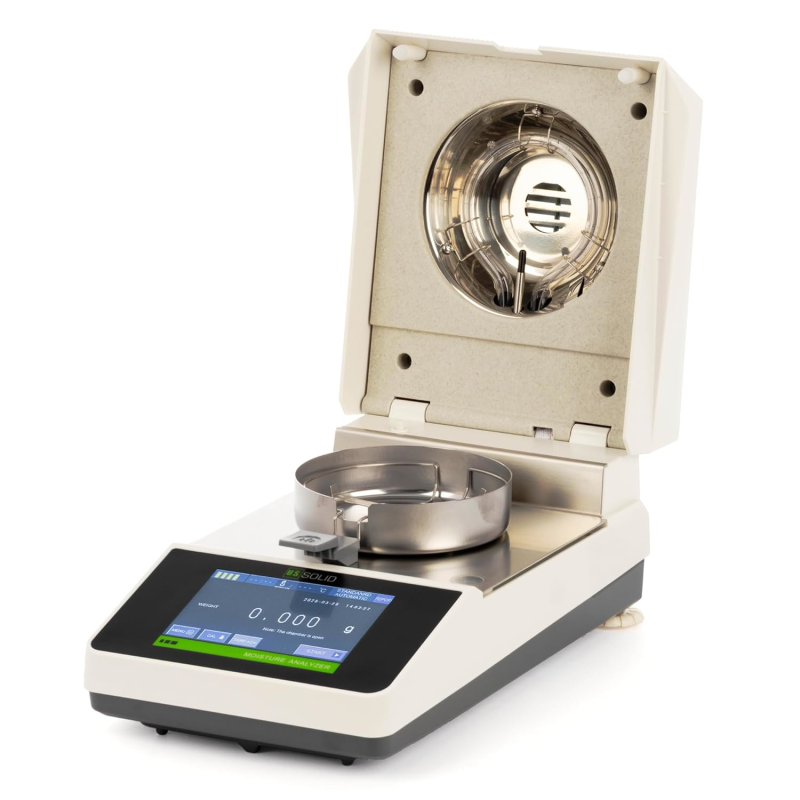
U.S. Solid Moisture Analyzer offers easy operation and high sensitivity for accurate moisture determination. With smart functions to store methods, a 250W halogen lamp, and premium transducer, it delivers fast results, even for low-moisture samples. Compact and user-friendly.
Testing Modes and Ending Options: The moisture analyzer provides users with a versatile range of testing modes, including standard, fast, and soft, as well as three distinct ending modes: auto, timing, and manual
Interactive Touch Screen Display: Enhancing user experience, the moisture analyzer boasts a responsive 5-inch touch screen interface. Users can easily control the device by tapping the screen, while also being able to view real-time moisture testing
Customized Testing Parameters: Users have the flexibility to tailor the testing parameters to their specific requirements. Adjust the heating temperature within the range of 40-160°C and set the heating time anywhere between 1 and 99 minutes for precise
Efficient Preheat Function: The moisture balance is equipped with an advanced preheat function that significantly expedites the heating process. This feature ensures faster attainment of the desired temperature, streamlining the overall testing
Seamless Data Transfer Capability: For effortless data management and analysis, the moisture analyzer is designed with an RS-232 interface that facilitates seamless data transfer and retrieval. This feature enables users to efficiently transfer data for
Hazards
Thermal / burn — 250 W halogen element heats the chamber, pan, and pan support to ~160 °C; surfaces remain hot after the lid opens.
Fire — drying solvent-based inks, oils, or organic binders can ignite or flash; never run volatile/flammable solvents.
Fumes & smoke — heated organics, solvents, or some chemicals off-gas; inadequate ventilation can release irritant vapors.
Respirable dust — dried ceramic/clay residue and slips contain fine particulates (possible crystalline silica) that aerosolize during cleanup.
Splatter / boil-over — high-water slurries and slips can bubble and overflow the pan, fouling the chamber.
Electrical — 110 V mains; risk increases with spills or wet handling near the base.
7) Balance damage — sensitive load cell; knocks, overloading, or drafts ruin readings and can damage the sensor.
Things to Avoid
Drying flammable/volatile solvents, explosives, or anything that off-gasses hazardously.
Touching the pan, support, or chamber without heat protection.
Opening the lid during a run.
Exceeding the balance capacity or knocking the unit during weighing.
Cleaning with water/liquids while hot or near the electronics.
Compressed air or dry brushing on powder residue.
8 Running on an unstable, un-level, or cluttered surface, or with a damaged cord.
Safety Checks
Unit sits on a stable, level, draft-free bench (use the bubble level / leveling feet).
Power cord and plug undamaged; base dry.
Chamber, pan, and pan support are clean and cool from the prior run.
Pan support seated correctly; correct clean pan in place.
No flammable materials or solvents adjacent to the unit; ventilation adequate for your sample.
Confirm the sample is appropriate — not flammable, explosive, or strongly volatile.
Operational Checks
Preheat (one-click) and confirm the unit is stable before the first sample.
Tare the empty pan, then load a thin, even layer (~3–10 g typical) — even coverage dries uniformly and prevents splatter.
Choose the drying mode (Standard / Fast / Soft) and a temperature appropriate to the material; don't exceed a temp that scorches or oxidizes the sample.
Pick the ending mode (Auto / Timing / Manual) and close the lid fully before starting.
Do not open the lid mid-cycle; watch for smoke, splatter, or boil-over and stop the run if it occurs.
Let the result register, then allow the chamber to cool before removing the pan.
Cleanup
Let the chamber, pan, and support cool fully before touching.
Remove the pan with the handle/tongs; dispose of residue per its waste stream (hazardous/chemical samples to the proper container, not the trash).
Wipe the chamber and pan support with a dry or lightly damp cloth once cool — keep moisture away from the base and electronics.
For ceramic/powder residue, wipe with a damp cloth or HEPA vacuum — never dry-brush or use compressed air (aerosolizes silica).
Return pans and tools, log usage, and power down.